
 English
In industrial production involving powders, particles, slurries, and even high-viscosity materials, the selection of mixing and blending equipment directly affects product quality, production efficiency, and operating costs. When faced with the wide variety of mixing machine types available on the market, many purchasing managers often feel confused: Horizontal helical mixer, planetary mixer, paddle mixer, drum mixer, drum-type mixer… What are the differences among them? And which production scenarios are they suitable for?
This article will explain the working principles and application scenarios of these five types of industrial mixing machines in a simple and understandable way, helping you quickly find the equipment that best suits your production line.

Key words: High efficiency, Large capacity, Main equipment for powder mixing
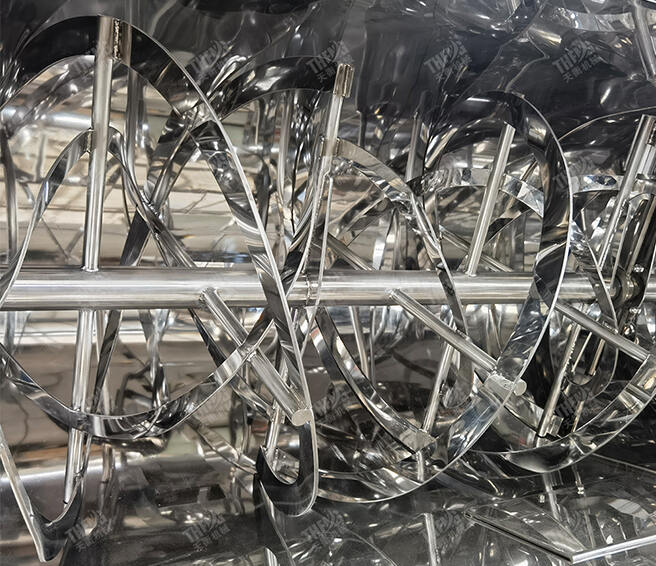
The horizontal ribbon blender is one of the most widely used equipment in the industrial field of powder mixing. Its core structure is a U-shaped horizontal cylinder, there is a horizontal stirring shaft in the cylinder, the shaft is installed with two layers of screw belt inside and outside, two layers of screw belt screw direction opposite.
Working principle: When working, the outer screw belt will be close to the wall of the material from both sides to the center, the inner screw belt will be close to the axis of the material from the center to both sides. The materials form a strong convection circulation and shear mixing within the cylinder. Usually, a batch of materials can be uniformly mixed within 8 to 10 minutes. In simple terms, it is like having two hands in the cylinder from different directions to “flip back and forth”, the material is repeatedly folded, interwoven, and finally reaches a highly uniform state.
Application scenarios: horizontal screw belt mixer is particularly suitable for solid-solid (powder and powder) and solid-slurry (powder and glue slurry) mixing. In chemical, food, pharmaceutical, building materials (putty powder, dry powder mortar), feed and lithium battery materials and other industries have mature applications. The equipment has a high loading coefficient, clean discharge, and can be equipped with heating/cooling jackets to achieve temperature control during the mixing process.
Key words: High viscosity, No dead corners, Precise mixing
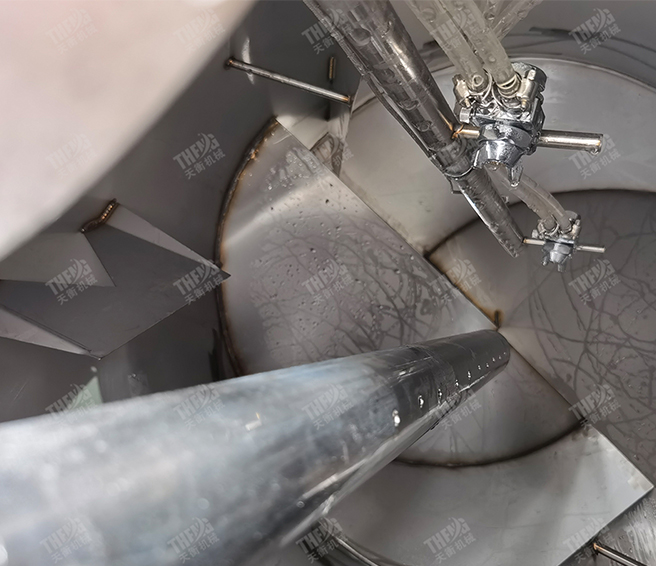
Planetary mixer is a kind of high-end mixing equipment designed for high viscosity and high solid content materials. The name comes from “planetary motion” — the stirring paddle rotates around the center axis of the vessel while also rotating at high speeds around its own axis at different speeds, just as the planets in our solar system move around the sun.
Working principle: There are two multi-layer paddle-type mixers and a scraper blade inside the vessel. The paddles rotate both around the central axis of the vessel and at high speeds around their own axes, causing the materials to be subjected to intense shearing in the vessel. There are no dead corners during the mixing process. The scraper blade constantly scrapes the materials adhering to the vessel wall back to the mixing area, ensuring overall uniformity.
Application scenarios: The planetary mixer is suitable for high-viscosity materials. Typical applications include lithium battery pastes, electronic electrode pastes, sealants, silicone adhesives, inks, pigments, ointments, cosmetic pastes, toothpaste, chocolate pastes, etc.
Key words: Large tonnage, Continuous type, Rolling mixing
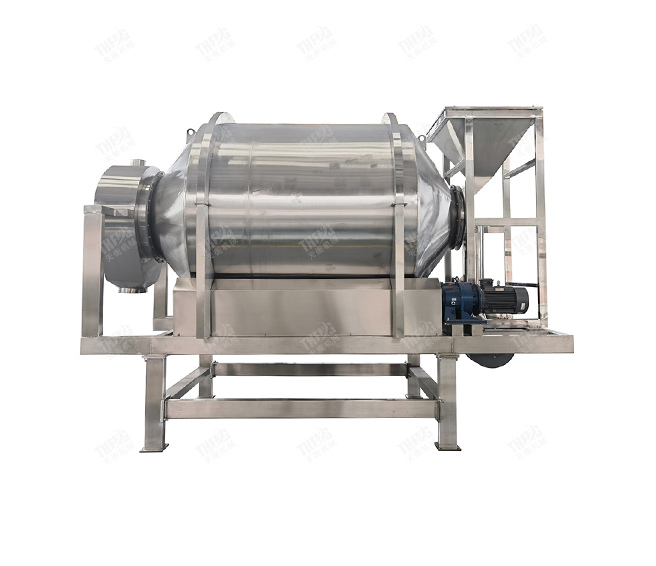
The drum mixer relies on the rotation of the cylinder to continuously stir the internal materials and achieve mixing. The main body of the equipment is a horizontal cylinder, which is supported by idler rollers and driven to rotate by a transmission device.
Working principle: After the materials enter the cylinder from the feed port, they are continuously lifted and thrown by the internal material lifting plates as the cylinder rotates. Through repeated rolling, the mixing is completed. Due to the certain inclination of the cylinder, the materials will also move forward slowly during the mixing process. Therefore, the drum mixer can operate intermittently or continuously.
Application scenarios: The drum mixer is particularly suitable for large-tonnage and large-volume material mixing. It is used for concrete and mortar mixing in the building materials industry, and also has applications in the pharmaceutical, food, and chemical industries.
Key words: Container rotation, Small batch, High uniformity
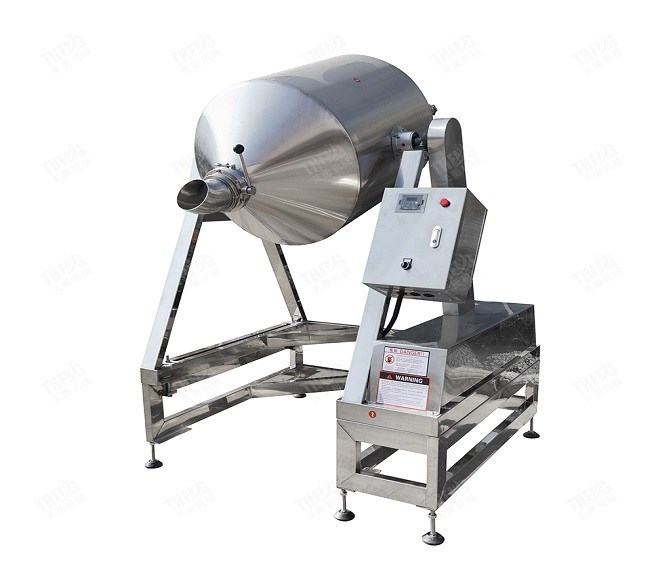
The drum mixer and the drum mixer are easily confused in name, but they have essential differences. The drum mixer usually adopts a waist-shaped rotating cylinder, and the interior of the cylinder is equipped with independent stirring blades. It is a composite equipment that combines “container rotation + internal stirring”.
Working principle: During operation, the cylinder rotates around the axis for 360 degrees, causing the materials to undergo chaotic rolling movements, enabling rapid and uniform mixing within the cylinder. Due to the rotation of the cylinder itself, there is almost no centrifugal force acting on the materials during the mixing process, so there will be no phenomenon of density segregation and stratification.
Application scenarios: The drum mixer is suitable for the uniform mixing of various powdered and granular materials. Even if the added ingredients are very little, it can still achieve a good degree of mixing. It is mainly used in industries such as feed, chemicals, pesticides, food (such as edible salt, Chinese herbal powder, sugar, flour), magnetic powder, ceramics, etc.

If your production mainly involves the mixing of powders with powders or powders with slurries, aiming for large capacity, high efficiency, and clean discharge, a horizontal screw mixer is usually the most cost-effective option. If you are dealing with high-viscosity pastes and have requirements for mixing accuracy, a planetary mixer is more suitable. For the routine mixing of low-viscosity liquids, a paddle mixer is sufficient and has the lowest cost. For the processing of large-tonnage minerals and industrial raw materials, a drum mixer is a mature and reliable choice. And small batch, high uniformity, strict hygiene requirements of powder mixing, drum mixer is worth considering.
If you are hesitant to choose a powder mixing equipment, please contact our technical team, we will recommend the most suitable configuration for you according to your material characteristics, capacity requirements and workshop conditions.

